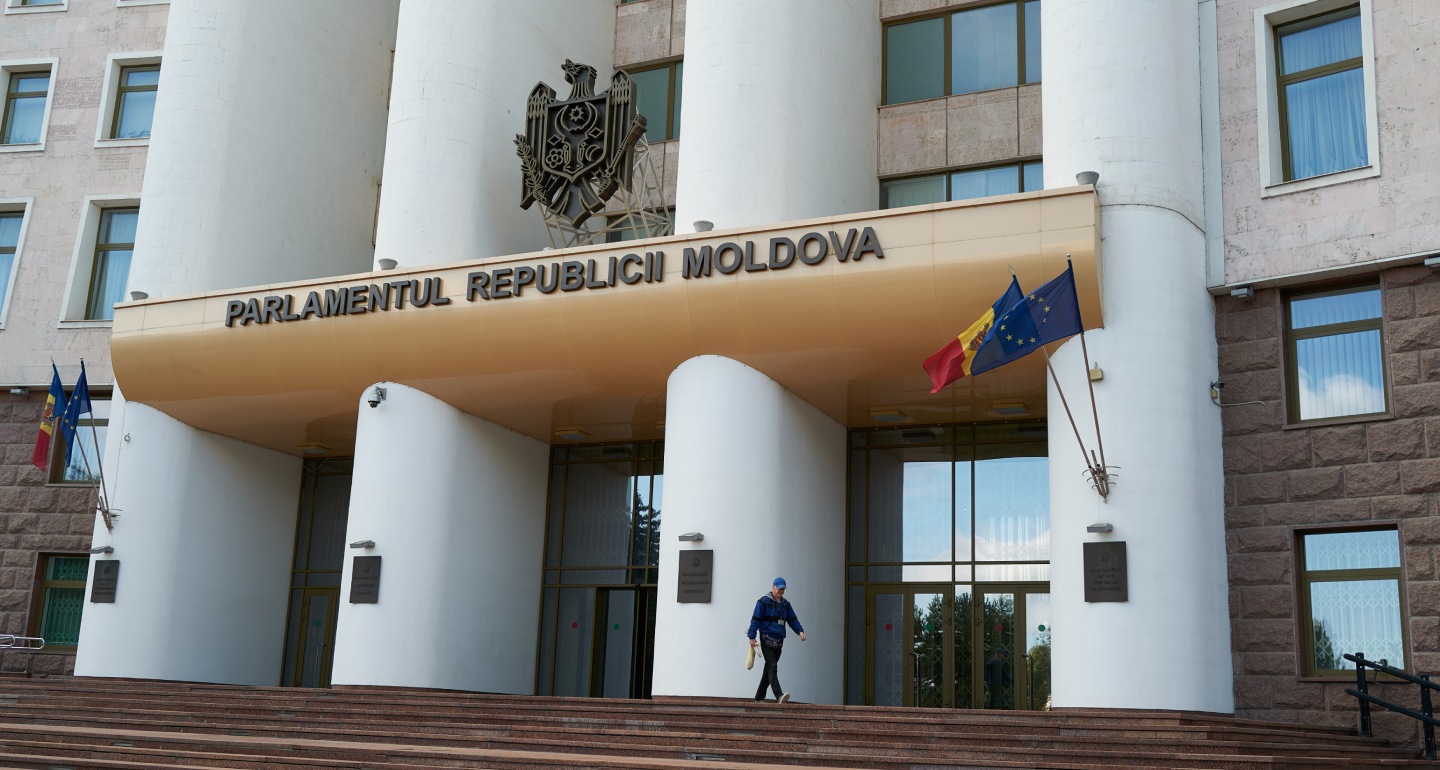
In recent days, there has been much discussion in Moldova about a leaked informal plan by the country’s leadership to solve the issue of its breakaway region of Transnistria. No Moldovan official has questioned the document’s authenticity. It’s unclear whether Moldovan Deputy Prime Minister Valeriu Chiveri presented the non-paper at his March 12 meeting in Brussels with Marta Kos, the European Union’s Commissioner for Enlargement, but there’s every indication that the fourteen-page document was written with a Western audience in mind.
The leaked document was in English, and it doesn’t appear to have been discussed with anyone in Moldova apart from EU diplomats. In private, those diplomats say that even the Organization for Security and Co-operation in Europe (OSCE), which has had a mission in Moldova since 1993, hasn’t seen the document. It’s likely that the OSCE has been frozen out because Russia is a member—and, given Russia’s ongoing aggression against neighboring Ukraine, Moldova doesn’t want Moscow involved.
For the time being, the plan is unofficial and doesn’t reflect Chișinău’s final position. But considering that Chișinău declined to take the initiative for many years, even a rough roadmap like this is a major step. The paradox of Moldova’s new plan, however, is that it strongly implies that Moldova’s problem will be solved for it.
Chișinău’s reintegration plan follows a noticeable shift in the EU’s approach to Moldova in recent months. Early on in the Russia-Ukraine war, EU officials offered unconditional support for the current Moldovan leadership, refrained from pressing Chișinău on sensitive issues, and allowed for the possibility that the two parts of Moldova could join the EU at different times, with Transnistria joining later.
After Moldova’s pro-Europe Party of Action and Solidarity won crucial parliamentary elections in 2025, however, the EU changed tack. Brussels now seems to believe that Chișinău should swiftly come to grips with the Transnistria conflict. EU officials have begun saying this regularly—and publicly.
The fourteen-page document is Moldova’s response. In some ways, it is a plan—most significantly in that it establishes the goal of peacefully reintegrating Transnistria and lists the steps Chișinău believes need to be taken. At the same time, the word “approaches” in the title of the document (“Basic approaches in the process of the gradual reintegration of the Transnistrian region”) implies that what is being proposed is provisional.
The non-paper contains quite a few innovations. For example, no previous Moldovan government has disputed the necessity of giving Transnistria a special status within a united Moldova—but the new document does not mention any such status. Indeed, political aspects of the settlement are left out of the equation.
Instead, it stresses that: “The Republic of Moldova is the sole subject of international law and the territory of the Transnistrian region constitutes an integral part of the Republic of Moldova.” Chișinău is thus signaling that all sides of the conflict are not equal (a claim Tiraspol liked to emphasize during negotiations in the 5+2 format, which in addition to Moldova and Transnistria includes the EU, Russia, Ukraine, United States, and OSCE).
New realities in Eastern Europe after Russia’s full-scale invasion of Ukraine have shaped the plan’s outlook. Chișinău is clear it no longer intends to work with Russia on Transnistria. Instead, it sees Russia as a threat and an obstacle to the restoration of Moldovan territorial integrity. The document notes the “the Russian Federation’s propensity to use military force as a foreign policy tool,” and that “Russia has not lost interest in the region; on the contrary [...] its interest has increased,” despite its diminished capabilities.
Moldova looks to its Western partners to handle Russia’s military presence. “In the current geopolitical context,” the document states, “it remains necessary to increase international pressure on the Russian Federation to withdraw its illegally deployed forces, as well as to internationalize and demilitarize the peacekeeping operation.” The withdrawal of Russian troops and the removal of Russian military equipment should, the document contends, be carried out under international supervision.
Another new feature of the plan is a frank admission that negotiations cannot resolve the Transnistria issue. The 5+2 format is dysfunctional, according to the document, and “the political will to meet the prerequisites for a viable settlement has been lacking in Moscow and Tiraspol. This is an impediment to meaningful negotiations.”
However, that does not mean that Chișinău wants to completely sever contact with Tiraspol. The document envisages dialogue continuing in a 1+1 format (meetings between representatives of Chișinău and Tiraspol). At the same time, the Moldovan government is not expecting a breakthrough and instead intends to carry out reintegration by gradually extending Moldovan law to the unrecognized state (a process that has already been underway for several years).
“Experience suggests that negotiations have limited chances of concluding with consensus,” the document states. “For this reason, through legislative amendments, uniform rules of the game will be applied, requiring strict compliance with the national legal framework, as well as with fiscal, customs, and trade regulations throughout the country’s territory.”
Significantly, the plan specifies a transition period as part of reintegration—during which Transnistria will be managed by an internationally appointed administration. In time, this administration would gradually hand powers to Chișinău. The idea of such external governance has not previously been discussed in public—nor has it ever been mentioned in official Moldovan documents. However, it follows on logically from Chișinău’s concerns about gaining sudden control over a region with its own security agencies and established political system.
As for the current peacekeeping mission in Transnistria, staffed by Moldovan, Russian, and Transnistrian soldiers, Moldova’s plan proposes that it be replaced by an international civilian mission. Chișinău appears to believe this is something its international partners should take it upon themselves to organize: “[...] the success of the initiative depends on the firm commitment and sustained support of international partners.”
Finally, the Moldovan government insists that its EU integration should proceed separately from unification with Transnistria, and that the latter should not be allowed to slow the progress of the former. “The two processes advance at different speeds and follow distinct timelines,” the document states.
Considering what EU officials have said previously, it’s by no means certain that Brussels would support that approach. And at least unofficially, European diplomats have already voiced their dissatisfaction with the plan to Chișinău. In particular, they object to the idea that the EU should assume responsibility for resolving the Transnistria conflict. The document’s apparent lack of an overall strategy also makes it a hard sell.
In fairness, Chișinău appears to be prepared for such a reaction, and to rework the plan. There is no sense of urgency about any of the outlined goals—and that’s by design. In essence, Moldova’s reintegration plan was drawn up to demonstrate to Brussels that Chișinău is serious about the Transnistria issue, and to get the West to react. On the basis of that reaction, the plan can be fine-tuned accordingly.